TREKKING TO BELUCHA
You can go to the holy mountain
Belucha by walking with your rucksac. This is the normal way to
do. Our Dutch group goes this year (2002) with horses to Belucha
and that makes the trekking more expensive. Without horses it
is much cheaper. Ask fot those details Lenalp Tours in St. Petersburg.
You will find the link to their e-mail addres in the bottom of
this page.
The path to Belucha goes through
the fields, mountains and sometimes small rivers.

Akkem
You can do the trekking in
9 days, that is very hard to do, or in 12 or 14 days. You can
decide this by yourself with the Russian organisation. In 4 or
5 days you go through fields, woods, mountains to the second basecamp
near Belucha. There you will have some days to stay and make daytrips
to beautiful lakes, seven lakes, with different colours, to the
Gate of Shamballa, to the Yarlu valley, to the gletsjer mouth
of Belucha, whatever you want or is possible. You go with a Russian
guide, English spoken.
Overnight you sleep in your
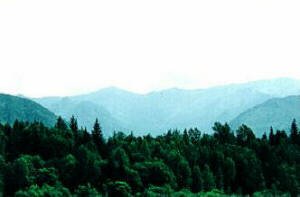
tent. You rise from 850 meter in four-five days to about 2200
meter and sometimes higher, in fields with flowers and herbs and
in the woods of the famous Siberian ceddars and the famous Altai
blue energies.
There are some special places
with high energy, stones too, on the way to Belucha. The guides
will give you those information during the trekking.

One of the Seven Lakes
After the days near Belucha
you will cross the Karaturajek pass. This day is difficult.
You will go to about 3300
meter high. On the top of the pass you see Kazachstan, China and
Mongolia.
The way down to our overnihgt
tentcamp is not so difficult and takes some hours too. You can
go the next day to the Kutcherla lake and from there you go back
to the basecamp in Tyungur, along the banks of the river Kutcherla.
On this path you will visit the ancient rockpaintings and a spring
with healing water.

The Karaturajek pass.
In the basecamp they prepared
the banja for you and in the Katun river you can wash your clothes
and the next day you can relax.

1994
Photo's and text: Fransje
Bik